Auspicious Aspects of an Ancient Landscape
Rather than applying traditional Feng Shui rules rigidly, this page explores how landform, direction and natural movement shape the feeling of place at Waterfall Wedding. These qualities are inseparable from the site’s physical setting and location.
The focus here is not superstition or prescription, but spatial awareness – how the surrounding environment creates balance, containment and openness in ways that many cultures recognise intuitively.
Directional Landscape Context
The venue is positioned on a high plateau, with higher mountain ranges and forested land forming a protective arc from the south-east through south and south-west to west. These landforms create a sense of backing and grounding, shaping how the space feels when people arrive and gather.
To the east, the landscape opens into farmland and grazing country, allowing light, outlook, and long views across lower ground. To the east (and along the broader coastal plain), there is a distant ocean influence, contributing a subtle sense of horizon and openness rather than exposure.
Together, this creates balance – elevation without isolation, openness without vulnerability.
Water, Movement & Containment
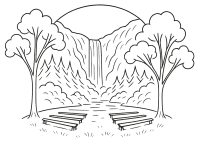
Water in the surrounding landscape does not pass through or drain away from the venue grounds. Instead, it moves through the surrounding valley below and behind the venue, wrapping past the south-western side of the landscape before continuing north.
In Feng Shui terms, this is often read as adjacent movement rather than loss. Water remains present, audible, and perceptible in the wider environment, while the ceremonial ground itself stays dry, elevated, and intact.
The land remains held and stable, while movement occurs in relationship to it rather than through it. Symbolically, this suggests rhythm without erosion – energy that circulates through the surrounding valley while the centre remains steady.
A Contemporary Interpretation
In modern contexts, Feng Shui is best understood as a language of orientation rather than rules. Many couples respond not to labels, but to how a place feels: supported behind, open ahead, grounded underfoot.
This landscape offers:
- containment without enclosure
- movement without instability
- openness without exposure
For couples beginning a shared life, these qualities often resonate quietly, without needing explanation.
Like all symbolism, this reading is an invitation, not a requirement – a way of noticing how place can reflect intention, rather than dictate it.
Reading this page
Some couples like symbolism. Others simply notice how a place makes them feel.
The sections below explore how landscape, orientation, movement, and transition quietly shape experience during a wedding day. You do not need to hold any particular belief to read this page. These ideas are offered as context rather than instruction, drawing on shared human responses to space, environment, and place. These ideas are reflected throughout the design and layout of the Waterfall Wedding venue.
Each section can be opened or read independently. Together, they describe why certain settings feel grounding, supportive, and right at moments of commitment.
Different moments, different spatial needs
Although ceremony and reception may take place within the same broader landscape, they serve distinct emotional and psychological functions. The way a space is held – its orientation, containment, and outlook – subtly shapes how each moment is experienced.
Rather than separating these moments artificially, the landscape at Waterfall Wedding naturally supports this transition.
Ceremony spaces
Ceremony benefits from a sense of pause, focus, and containment. At Waterfall Wedding, this is supported by the surrounding higher land to the south and west, which creates a feeling of backing and stability. The environment feels held, grounded, and calm – qualities that support presence, attentiveness, and meaning during commitment.
Reception spaces
Reception, by contrast, thrives on openness, movement, and connection. Gentler gradients and outward views toward the east and north allow energy, people, and conversation to flow more freely. This openness supports celebration, circulation, and shared joy without feeling exposed.
This natural differentiation allows each part of the wedding day to feel distinct – ceremony as a moment of intention and focus, reception as a moment of connection and release – without needing rigid boundaries or prescribed movement.
In spatial terms, this is balance: containment where it matters, openness where it’s needed.
Why these elements appear across cultures
Across cultures and centuries, weddings have used water, height, and passage as markers of transition. These elements are not symbolic because of belief systems, but because they reflect how humans experience change physically and emotionally.
Water signals movement.
Elevation signals perspective.
Thresholds are the moments where people feel a change taking place – arriving, pausing, or stepping into what comes next.
Together, they create a language of transition that is intuitive rather than taught.
Water as presence, not possession
Across cultures, water is associated with continuity, renewal, and adaptability. It rarely symbolises control or certainty. Instead, it reflects life as something that moves, responds, and reshapes over time.
At this site, water is not within the venue grounds. It exists below and behind the venue in the surrounding valley, remaining present in the wider landscape without intruding into the space where people gather.
Symbolically, this suggests movement without destabilisation. Energy is nearby and perceptible, while the ground beneath the ceremony and celebration remains calm, dry, and grounded. For many couples, this mirrors a healthy partnership – connected to change without being unsettled by it.
Elevation as clarity, not status
Elevation has long been associated with awareness and intention. Standing slightly above surrounding land offers perspective, allowing people to see beyond immediate detail and orient themselves within a wider context.
The venue’s position on a plateau reinforces this effect. Arrival involves a gentle rise rather than an abrupt ascent, creating a subtle sense of transition without drama. The landscape invites reflection while remaining connected to what lies around it.
In symbolic terms, elevation here supports the idea of choosing partnership consciously, with awareness of the broader life being entered rather than a single moment being performed.
Thresholds and the power of crossing
AA threshold is any point where one state ends and another begins. In weddings, thresholds appear repeatedly, often without being named.
They include arriving at the site, walking toward a ceremony space, the pause before vows, and the movement from ceremony into celebration.
These moments matter because the body recognises them even when the mind does not. Crossing a threshold allows emotion to catch up with intention. Spaces that honour thresholds by allowing time, distance, or a change in outlook tend to feel calmer and more meaningful.
Old traditions, modern relevance
Many well known wedding traditions are rooted in symbolic protection or transition rather than prediction.
Something old represents continuity.
Something new reflects intention.
Something borrowed symbolises community.
Something blue has long been associated with calm and trust.
Rain on Your Wedding Day has similarly been interpreted across cultures as renewal or abundance, not because it promises outcomes, but because it reflects life unfolding as it is.
These ideas persist because they offer language for emotion, not instruction.
Holding symbolism lightly
Symbolism works best when it is noticed rather than imposed. It does not require belief, nor does it demand interpretation.
Many couples find value not in asking what something means, but in noticing how it feels. Water nearby but not intrusive. Elevation without isolation. Clear moments of crossing between stages of the day.
When symbolism is held lightly, it supports meaning without pressure and context without expectation.
The response comes before the reasoning
Many couples describe a moment of knowing when they arrive at a place that feels right. It often comes before practical questions or logical assessment. The response is physical and immediate, a sense of calm, clarity, or quiet certainty.
This reaction is not sentimental or abstract. It is perceptual. Humans are highly responsive to spatial cues related to safety, orientation, and balance, even when they cannot consciously articulate why.
How the body reads space
Environmental psychology shows that people feel more at ease in places that offer a combination of shelter and outlook. These conditions allow awareness without vigilance.
Common features of spaces that feel grounding include:
- clear orientation on arrival
- natural boundaries without enclosure
- open outlook paired with protection behind
- visible depth in the surrounding landscape
When these elements are present, the nervous system settles. Attention broadens. People feel more present and less guarded.
Familiar patterns across time
Across cultures and eras, places chosen for gathering, ceremony, or decision often share similar spatial qualities. Slight elevation, shelter at the back or sides, and openness ahead appear repeatedly, not as symbolism, but as practical responses to human needs.
These patterns endure because they work. People feel supported without feeling constrained, and connected without being exposed.
Modern couples respond to these same cues instinctively, even if the language used to describe them has changed.
The role of transition and arrival
Places that feel right usually allow for arrival rather than immediate immersion. A change in ground, light, sound, or orientation signals that something distinct is beginning.
These transitions matter. They help the body register that this moment is different from everyday life. When arrival is honoured, people settle more quickly and engage more fully.
For weddings, this creates space for emotion to surface naturally rather than being rushed or performed.
Why this matters on a wedding day
Weddings carry emotional density. Anticipation, vulnerability, and expectation all arrive with the people attending.
When a setting supports calm focus:
- couples feel more centred
- guests become present more quickly
- moments feel sincere rather than staged
The environment quietly does part of the work, allowing people to relax into the experience rather than manage it.
No belief required
You do not need to subscribe to symbolism or tradition to experience this response. The sense that a place feels right is grounded in perception, not belief.
It comes from legibility of space, balance of elements, and respect for human movement and pause. These are universal responses, not cultural rules.
Trusting the instinct
When couples say a place feels right, they are often responding to a deep alignment between intention and environment.
That instinct is worth trusting.
Because places that feel right tend to support the moments that matter, without needing explanation at all.